First-Person-View (FPV) Drone
System design & compatibility · 3D printing · Soldering · Assembly · RPAS license and safety
I independently designed and built several high-performance FPV multi-rotor drones as a personal passion project, combining my love for flight, film-making, and electronics. I managed all aspects of system design, from component selection, wiring, soldering, assembly, test, and operation. Below are two of my latest, with another special project in the works.
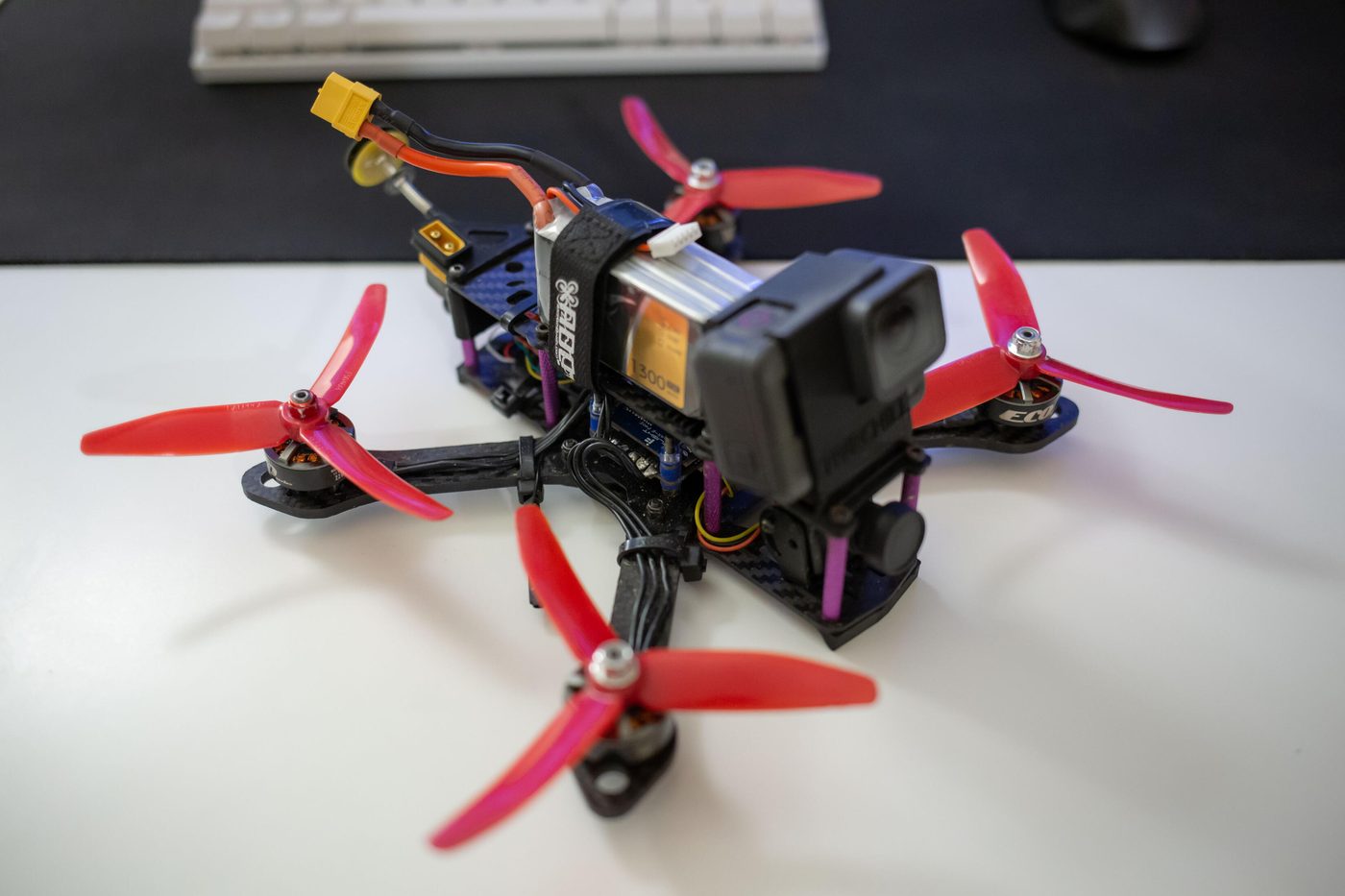
I started this build with a 5 inch carbon-fiber frame, optimized for high chassis stiffness and low weight. I selected an F4 flight controller and 4-in-1 electronic speed controller as the main brain and central "stack" of the system. Then, motors, props, and a receiver with the desired control link (FrSky was popular at the time), and a 4S LiPo as the power source. Lastly, a CCTV video camera and analog video transmitter send a live cockpit view to a headset. Components were assembled, wires soldered to pads, firmware flashed, props tightened down, and this drone had its maiden flight.
I used SolidWorks to design and 3D-print a custom camera mount, strain-relieved battery connection, and antenna mount. Battery safety was prioritized through per-cell internal resistance checks (<15 mΩ), maximum 1C balance charging, and storage in fireproof containment bags inside ammunition boxes. Holding a Transport Canada basic RPAS Pilot Certificate under Part IX, I conduct all flights under strict safety and airspace protocols.
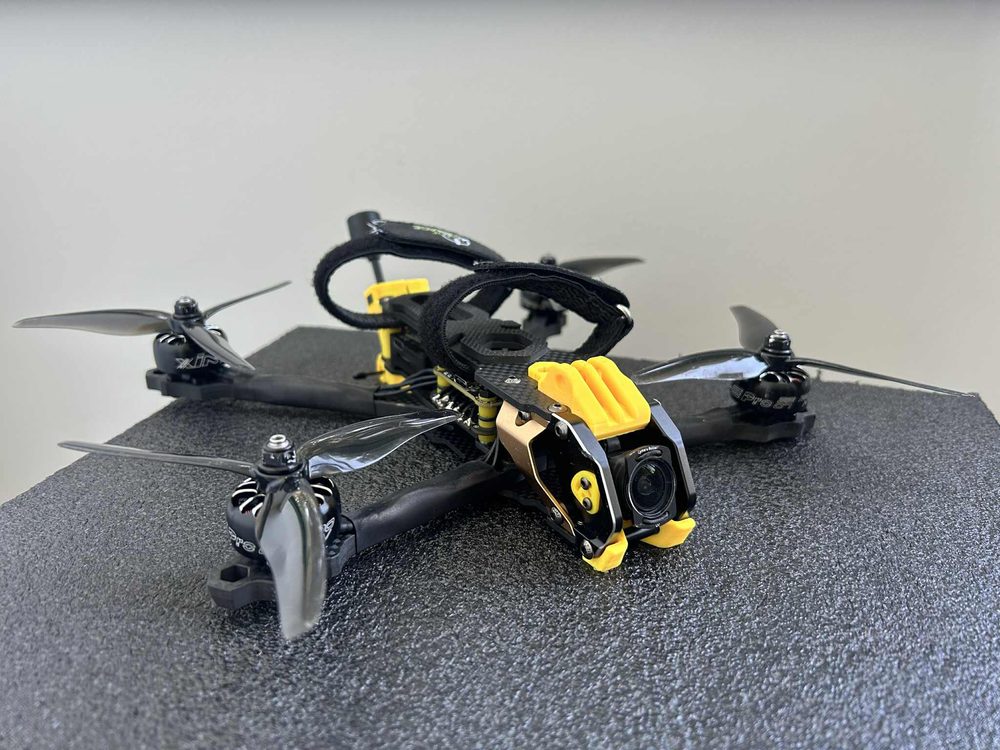
In the latest iteration, I shed 120 grams by switching from analog to digital video, boosting flight time by 60%. The digital video system allows for high quality first person view in the goggles while recording to an onboard micro-SD card, instead of carrying a dedicated GoPro action camera.
I also changed from 14.8 V 4S to larger 22.2 V 6S batteries, requiring a higher power ESC, flight controller, and lower KV motors. The overall result is a refined ~900 g platform, capable of 120 km/h punch-outs, precise freestyle manoeuvres, and sustained 10+ minute cinematic flight while recording at 4K.
In the air
| Item | Part |
|---|---|
| Frame | SpeedyBee Mario 5 DC |
| Motors | iFlight XING-E Pro 2207 1800kV |
| Flight Controller | SpeedyBee F405 V4 |
| Electronic Speed Controller | SpeedyBee BLHeliS 55A |
| Video Transmitter | DJI O3 Air Unit |
| Receiver | RadioMaster RP1 V2 ELRS |
| Propellers | Gemfan 51433 Hurricane |
| Battery | 6S1P 22.2 V LiPo |
| Firmware | BetaFlight 4.4 |
On the ground
| Item | Part |
|---|---|
| Transmitter | Jumper T15 ExpressLRS Radio |
| Goggles | DJI Integra |
| LiPo Smart Charger | ISDT Q6 Pro 300W/14A |